
Posted by Brian on Mar 8th 2026
Practical Guide to Recoil Spring Kits for 9mm Handguns
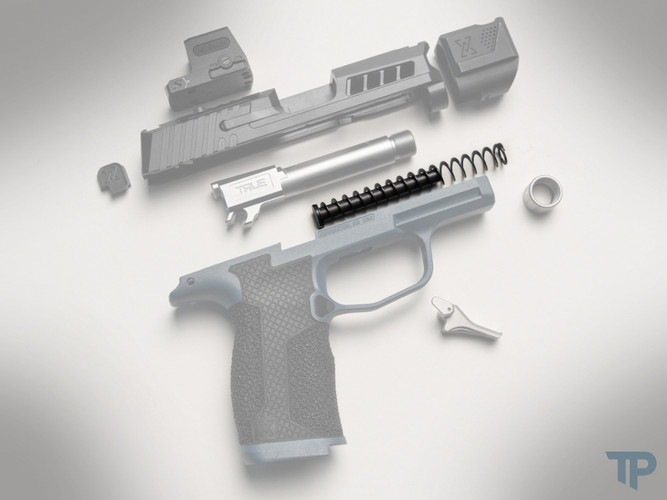
A recoil spring controls how the slide returns after a shot. Change the ammo, add a compensator or suppressor, or lengthen the barrel and the slide’s timing and energy balance change. A spring tuning kit gives you a range of spring weights so you can match slide return force to your specific setup and the ammo you actually shoot. This guide shows when to consider a kit, how to diagnose problems, how to test safely, and when to stop and call a gunsmith.
Quick FAQ: Short answers to common questions
When should I use a spring kit?
Use a kit when extraction, ejection, or feeding becomes inconsistent after you change ammo or add a muzzle device. Also use one when you switch to lower-energy practice loads or notice the slide is not cycling the same as before.
Can I just buy one spring and be done?
No. The correct weight depends on your pistol, barrel, muzzle device, and ammo. A kit with incremental steps lets you find the balance that works for your exact setup.
How do I know a spring is too light or too heavy?
Too light signs: slide returning too violently, brass ejecting too far or too hard, failure to fully lock into battery, or double feeds.
Too heavy signs: failures to eject, stovepipes, the slide not moving far enough to cycle, light strikes. If unsure, test methodically and record results.
How cycling works in plain English
When you pull the trigger the cartridge fires and the slide moves back, the empty case is pulled out and kicked free, then the slide moves forward and loads the next round. The recoil spring is what pushes the slide forward after it goes back. If the spring is too strong the slide might not move back far enough to eject the case. If the spring is too weak the slide can slam forward too hard and cause other problems. Two things commonly change how the slide moves: weaker practice ammo gives the slide less push, and a muzzle device like a compensator or suppressor changes the gases at the muzzle and can speed up or slow down the slide. When the slide moves noticeably faster or slower than before you can get failures to feed, stovepipes, or light strikes. Swapping to the correct recoil spring brings the slide timing back so parts extract, eject, and feed when they should.
When to consider a lighter spring and which pistols are sensitive
You should consider a lighter spring when you switch to lower-energy practice ammo, such as reduced-velocity rounds, when you add a compensator or suppressor, or when you put on a longer or heavier barrel or slide. If you notice ejection problems, stovepipes, or the slide not moving far enough to cycle after a parts change, a lighter spring is often the first thing to try.
Some pistols are more likely to need spring tuning than others. Compact pistols and designs with heavier slide assemblies often show sensitivity sooner. Examples to watch for include the Sig P365 family (P365, P365 Fuse, P365 XL), the Springfield Hellcat and Hellcat Pro, and other short-slide comped pistols. If you own one of these, plan to test spring weights soon after adding a muzzle device or changing ammo.
Spring Kits
for Sig
P365, P365 XL, FUSE, P320C
$59.99-$69.99
Spring Kits
for Glock
G43, G43X, G48, G19 Gen 1-6
$59.99-$89.99
Spring Kits
for Springfield
Hellcat & Hellcat Pro
$59.99
Spring Kits
for Ruger
RXM
$79.99
Quick troubleshooting and testing in plain steps
Symptom
You install a threaded barrel or compensator and start seeing inconsistent ejection, stovepipes, or weak ejection.
Quick test steps
-
Make the firearm safe. Unload, remove the magazine, and visually and physically check the chamber.
-
Remove the muzzle device but leave the new barrel installed.
-
Use the same ammo and magazine that showed the problem. Dry-cycle the slide a few times, then fire a few rounds.
-
If the gun works without the device, the device is likely the cause. Put the device back on, swap to the next lighter spring in your kit, and repeat the test sequence.
-
If the gun still fails with the device removed, inspect the extractor, ejector, barrel fit, and magazine condition, or stop and get a gunsmith involved.
Short weight guidance
Many 9mm factory springs fall around 16 to 18 pounds nominal, though manufacturers differ. If you add a compensator or run light ammo, try the next lighter spring in your kit (for example, 14 to 15 pounds). Treat kit numbers as starting points and confirm on the range with the magazines and ammo you actually use. If the slide starts returning too violently or you get double feeds, move up one weight.
Signs of trouble, safety, and warranty notes
You can use a non-factory spring, but always follow the pistol manufacturer’s guidance. Using non-factory springs can affect warranty and safety in some cases.
If you’re unsure or see cracked parts, pierced primers, abnormal slide/frame wear, or destructive behavior during testing — stop and consult a qualified gunsmith.
Replacing springs is normal maintenance, but improper installation or the use of incompatible springs can damage the firearm or cause unsafe malfunctions.
Bad magazines, worn feed ramps, a damaged ejector or extractor, or loose barrel fit can produce the same symptoms. Rule those out before blaming the spring alone.
Quick reference bench checklist and final tips
Bench checklist
-
Firearm cleared and unloaded.
-
Ammo type documented.
-
Magazine(s) specified and condition checked.
-
Muzzle device removed for baseline test.
-
Spring weights noted for each test.
-
Results logged after each test block.
Final tips
Keep a simple log that records which spring weight worked with which barrel, muzzle device, ammo, and magazine so you can reproduce reliable function later. Always test with the magazines you actually carry or compete with rather than a random box of mags at the range. If your gun is used for something critical like duty or personal defense, or if you see concerning signs during testing, stop and get professional help from a qualified gunsmith instead of guessing further.